


Deenstore
Saviours of Islamic Spirit – Tarikh-i Da’wat wa Azimat (PB) | authentic print. A New Revised and Edited Translation by: Shaykh Abul-Hasan ‘Ali al-Hasani Nadwi translation by: Shaykh Dr Abdur-Rahman Ibn Yusuf Mangera
Saviours of Islamic Spirit – Tarikh-i Da’wat wa Azimat (PB) | authentic print. A New Revised and Edited Translation by: Shaykh Abul-Hasan ‘Ali al-Hasani Nadwi translation by: Shaykh Dr Abdur-Rahman Ibn Yusuf Mangera
Regular price
Rs. 500.00
Regular price
Rs. 800.00
Sale price
Rs. 500.00
Unit price
per
Product Dimensions:
- Height: 14 cm
- Length: 21 cm
 Order on WhatsApp
Couldn't load pickup availability
| Author(s) | Shaykh Dr Abdur-Rahman Ibn Yusuf Mangera, Shaykh Abu ’l-Hasan ‘Ali al-Hasani Nadwi |
|---|---|
| Editor(s) | Shaykh Dr Abdur-Rahman Ibn Yusuf Mangera |
| Publisher(s) | White Thread Press |
| Pages | 282 |
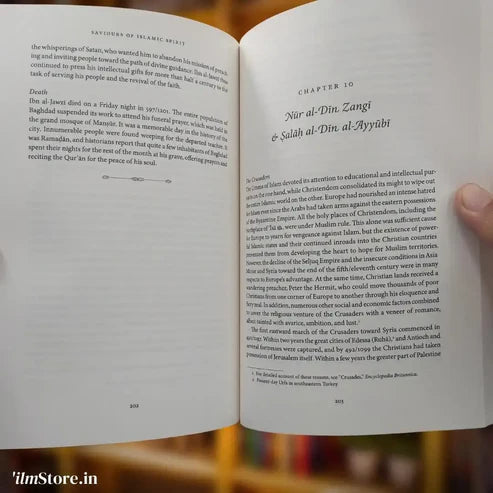
This book, by the late Indian historian and intellectual, Shaykh Abu ’l-Hasan ‘Ali Nadwi, is a story of the ebbs and flows of this Umma; the challenges, the setbacks, and most importantly, the successes. It is a poignant story of the accomplishments, attainments, and triumphs that propelled the Umma forward. It is a story told through extraordinary figures: the revivers, men of courage, vigor, and zeal, an elect group who were graced with divine determination to safeguard the spirit of God’s religion on earth. In other words, they were the saviours of the Islamic spirit.
Personalities covered
- Hasan al-Basri
- Ahmad ibn Hanbal
- ‘Abd al-Qadir al-Jilani
- ‘Umar ibn ‘Abd al-‘Aziz
- Abu ‘l-Hasan al-Ash’ari
- ‘Izz al-Din ibn ‘Abd al-Salam
- Abu ‘l-Faraj Ibn al-Jawzi
- Abu Hamid al-Ghazali
- Salah al-Din al-Ayyubi
- Nur al-Din Zangi
- The Tartars
-
Frequently Asked Questions
1. What is “Saviours of Islamic Spirit (Tarikh-i-Dawat wa Azimat)”?
“Saviours of Islamic Spirit” is the English translation of the seminal Urdu work “Tarikh-i-Dawat-o-Azimat” by Shaykh Abul Hasan Ali Nadwi (also known as Ali Miyan). It’s a multi-volume series that chronicles the lives and contributions of some of the greatest revivers and reformers in Islamic history. Essentially, the books profile those figures in different eras who rejuvenated the Islamic spirit and faith during times when it was weak or facing great challenges – hence they are termed “Saviours of the Islamic Spirit.”2. What does each volume cover, and how many volumes are there?
Originally in Urdu, there are 5 volumes of Tarikh-i-Dawat-o-Azimat, each covering a specific historical period and the major personalities of that period: - Volume 1 might cover early figures post the Sahaba, like Umar bin Abdul Aziz, or scholars of the early centuries. - Subsequent volumes go through the medieval period (imams, scholars, revivalists like Imam Ghazali or Salahuddin Ayyubi perhaps), then later periods including figures like Shaykh Abdul Qadir Jilani, Mujaddid Alf-Thani (Shaykh Ahmed Sirhindi), Shah Waliullah Dehlawi, and up to more modern times with people like Syed Ahmad Shaheed or even into the 20th century with scholars like Hassan al-Banna or Iqbal. (Exact contents vary; the translator might have combined or split differently in English.) The ilmStore listing uses the phrase in singular, which might imply they have a particular volume or maybe a compendium. But likely, they have at least the first volume or more of the translated series titled “Saviours of Islamic Spirit.” It’s a comprehensive history-cum-biography series.3. Who is the author Abul Hasan Ali Nadwi, and why is his perspective valuable?
Shaykh Abul Hasan Ali Nadwi (1914-1999) was a prominent Indian Islamic scholar, thinker, and writer. He had a deep grasp of Islamic history and was known for his engaging writing style in both Urdu and Arabic. His perspective is valuable because he doesn’t just list dry facts; he analyzes why these figures were “saviours” – what conditions were Muslims in and how did these personalities revive the faith. He draws lessons for contemporary times from historical events. His tone is very moving; many readers find his books spiritually uplifting, not just informative. He wrote this series to inspire Muslims by showing them their heritage of renewal (tajdid). Essentially, Nadwi’s work instills hope that whenever things seem dark, Allah sends guides to bring the community back – which is a powerful lesson.4. How can reading “Saviours of Islamic Spirit” benefit me?
There are a few benefits: - Knowledge of History: You’ll learn a lot about different eras of Islamic history, especially focusing on intellectual and spiritual movements rather than just political events. It’s like a tour through our heritage of scholarship and reform. - Role Models: Each “saviour” is like a case study in leadership, piety, and courage. For example, you may read about how Imam Ahmad ibn Hanbal stood firm on the truth during the Mihna (inquisition) or how Salahuddin not only fought the Crusades but also uplifted morality among Muslims. These stories serve as inspirational role models. - Context for Today: Ali Nadwi often subtly parallels past situations with modern times. You might find insights into present-day issues by seeing how earlier revivers tackled ignorance, disunity, or foreign cultural onslaughts. - Iman Boosting: Many readers feel a sense of pride and rejuvenation of faith reading about these giants of the past. It reminds us that Islam has a self-correcting ability through Allah’s guidance. So when you see challenges today, you remember that Muslims overcame worse before with sincere effort and Allah’s help. - Comprehensive Understanding: It broadens your understanding beyond one region or type of scholar. The series covers scholars, rulers, spiritual saints, and activists from various lands (Arabia, Indian subcontinent, Central Asia, etc.). So you get a global picture of Muslim efforts across time.5. Is the English translation readable? Sometimes historical works can be hard
The English translation of Saviours of Islamic Spirit is quite well done (translated by Mohiuddin Ahmad, if I recall correctly). It aims to retain Ali Nadwi’s narrative flair. So it is readable for a general audience; you don’t need to be a scholar to follow it. There might be occasional Islamic terms or non-English names, but usually with explanations or context so you can understand. Given ilmStore stocks it, they likely cater to educated readers who enjoy English Islamic literature. If you have an interest in history or biography, you’ll likely find it engaging. It’s not a light bedtime read (it’s packed with info), but it’s written more like an inspiring story than a textbook. Many find once they start a chapter on a personality, they get drawn into that story.


-

Urdu Translation In Roman Script
Easily understand Islamic teachings with Quran, Ahadees, and supplications in Roman Urdu....


